
Here’s a number that might make you pause: daily reading among young people aged eight to 18 in the UK dropped to just 18.7 percent in 2025. That means more than 8 out of 10 kids aren’t picking up a book, magazine, or even reading online content regularly.
But before you panic about the death of reading, let’s dig into what the numbers actually tell us. Reading statistics in 2025 goes way beyond simple decline narratives. Some trends might surprise you, others confirm what you suspected, and a few will completely flip your assumptions about how, when, and why people read today.
Here are statistics behind reading habits across different age groups, the rise of audiobooks and digital formats, regional differences that matter, and what these shifts mean for publishers, educators, and anyone who cares about literacy. The data reveals patterns you won’t expect and explains behaviors that seemed puzzling before.
Key Takeaways
The data gives us a clear picture of modern reading habits, revealing both concerning trends and surprising resilience in certain demographics. Here are the most significant findings:
- Only 18.7% of UK youth aged 8-18 read daily for pleasure, highlighting a dramatic shift in how young people spend their free time.
- Just 32.7% of children enjoyed reading in their free time as of 2025, down from significantly higher rates in previous decades.
- 83% of young adults (18-34) still read at least one book per year, showing reading doesn’t disappear entirely with age.
- Americans spend merely 7 minutes per day reading compared to over 7 hours consuming digital media content.
- The Asia-Pacific region commands 35% of the global book market share, demonstrating regional variations in reading culture.
- Digital distractions cause 51.95% of reading interruptions, making sustained focus increasingly difficult.
- Over 40% decline in leisure reading has occurred over the past two decades across American demographics.
Reading Habits & Frequency
The gap between youth and adult reading becomes clearer when you look at the broader picture. While UK youth struggle with daily reading rates, adult patterns tell a more complex story.
Overall Reading Rates
Recent surveys show that 65% of Americans haven’t read a single book in the past year. That’s a stark contrast to what you might expect in our information-rich world. The average American who does read manages about 12 books annually, though this number drops significantly when you factor in non-readers.
Daily reading time paints an even more concerning picture. Americans aged 15 and older spend just 7 minutes per day reading, according to Bureau of Labor Statistics data. For those between 15-44, that number shrinks to 10 minutes or less.
Demographic Breakdowns
Age Groups:
- 18-29 years: 83% read at least one book per year (highest rate)
- 30-49 years: Reading frequency drops to approximately
- 50+ years: More consistent reading habits but lower digital adoption
Gender Differences:
- Women consistently outread men across all age groups
- Female readers average 15-20% higher book consumption
- Men show preference for non-fiction and digital formats
Interestingly, 40.1% of UK youth read printed non-fiction books in their spare time, suggesting that while daily reading habits decline, interest in specific content types remains strong.
Education & Income:
- College graduates read 2-3 times more books annually
- Higher income brackets correlate with increased reading frequency
- 54% of adults read below 6th-grade level, affecting reading choices
Reading Formats & Preferences
That shift in demographics becomes clearer when you look at how people actually read. The format wars aren’t playing out the way many predicted – print books still dominate, but digital is gaining ground in interesting ways.
Market Share by Format
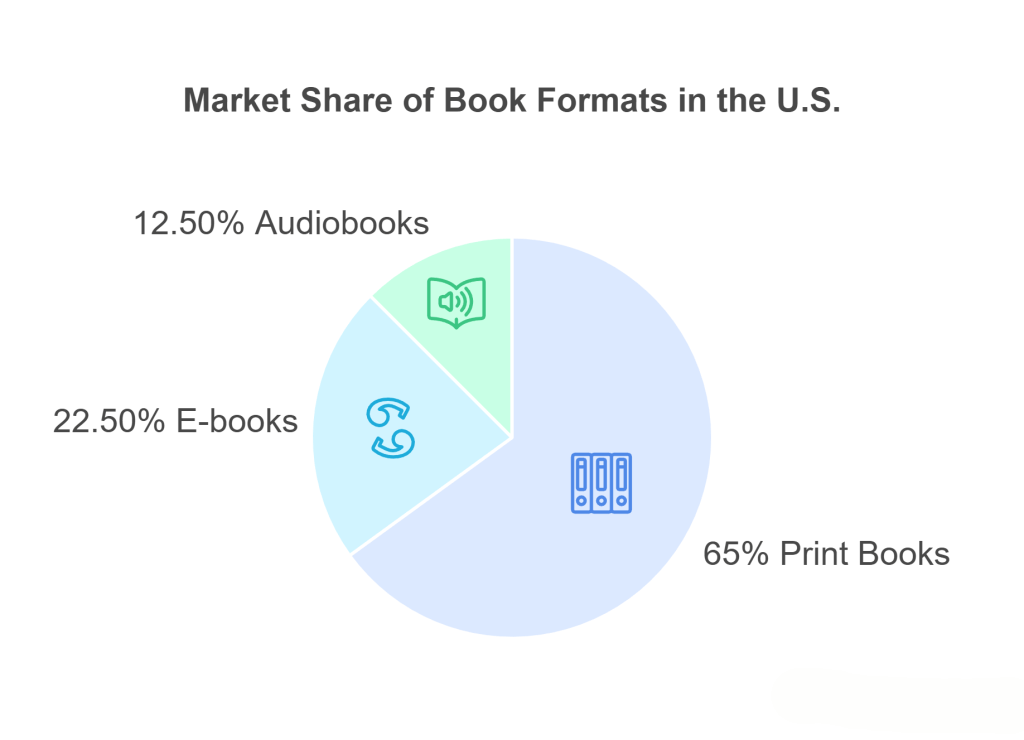
Print books continue to rule the market, capturing roughly 65% of all reading activity among U.S. adults. What’s surprising is how resilient this format has been. Despite years of predictions about digital takeovers, paperbacks alone account for 37.6% of trade sales.
E-books have carved out their steady 20-25% share, with the U.S. eBook market expected to reach 75.4 million users by 2029. But here’s what’s really shaking things up – audiobooks are exploding. The U.S. audiobook market hit $1.1 billion in revenue during 2024, growing 23.8% year-over-year. That’s not incremental growth. That’s a format revolution.
Global Reading Preferences
The global picture adds another layer. Asia-Pacific holds 35% of global book market share, and their format preferences lean heavily digital. This geographic split is reshaping how publishers think about distribution.
Genre Preferences by Format
What people read varies dramatically by how they read it:
- Fiction dominates audiobooks – especially romance, fantasy, and thrillers
- Self-help leads non-fiction across all formats but particularly in digital
- Biographies top print sales while psychology/self-help wins digital
- Romance and “romantasy” (romance + fantasy) drive e-book growth
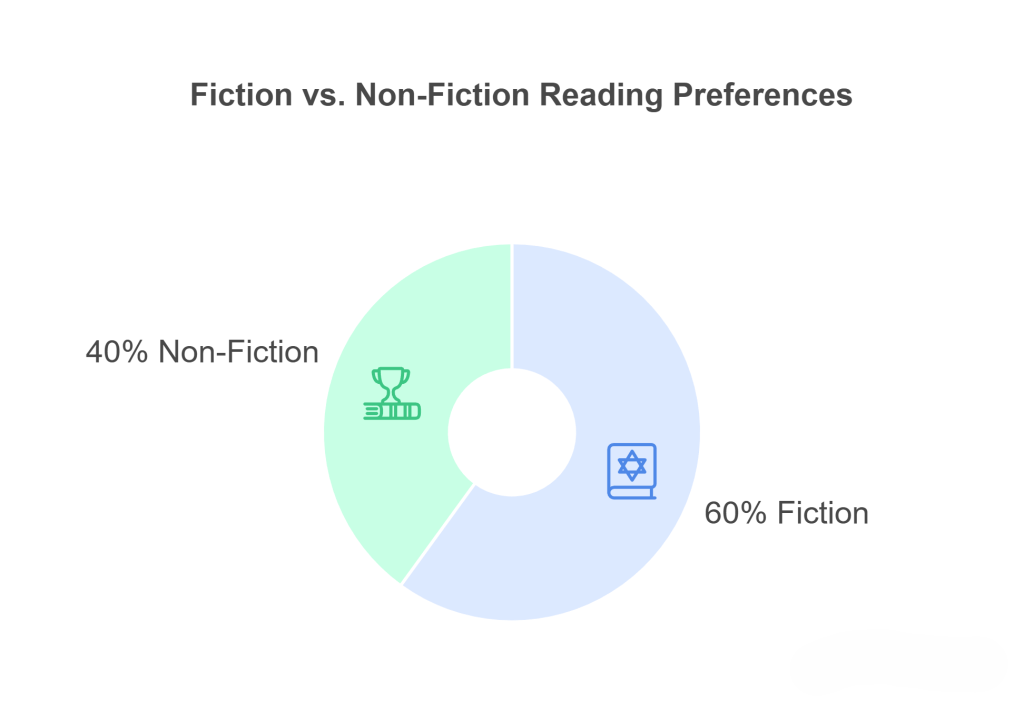
The fiction vs. non-fiction split sits at roughly 60-40 across all formats, but audiobook listeners skew more heavily toward fiction at about 70-30.
Demographic Details
Children (Ages 0-12)
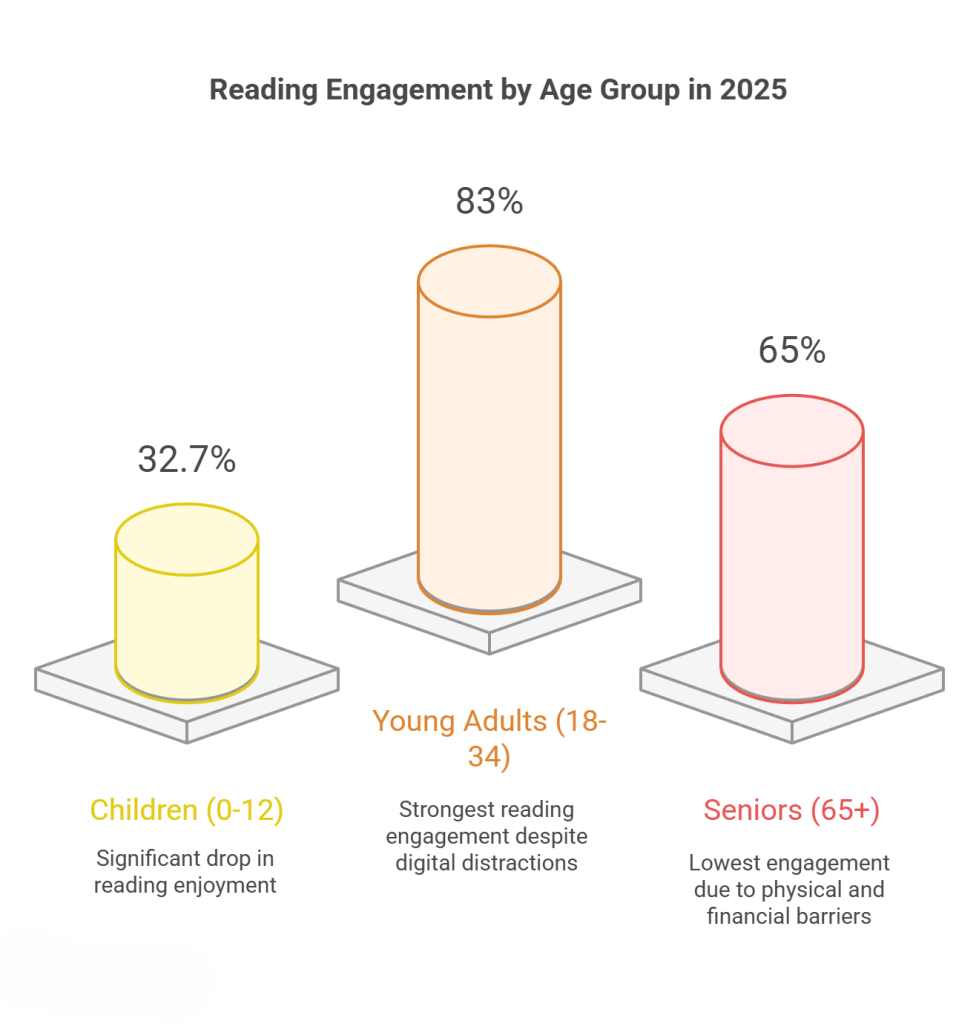
Here’s where things get concerning. Only 32.7% of children and young people aged 8-18 enjoyed reading in their free time in 2025, marking a significant drop from previous years. What you’re seeing isn’t just disinterest – it’s a fundamental shift in how the youngest generation interacts with written content.
- Picture books and illustrated stories still dominate preferences for ages 0-8
- Screen-based reading becomes more common around age 7-8
- Series books (like Diary of a Wimpy Kid) capture attention better than standalone titles
- Reading for school versus pleasure creates early negative associations
- Family reading habits directly influence children’s engagement levels

Teenagers (Ages 13-18)
This age group presents the biggest puzzle. They’re digital natives who consume content constantly, yet traditional reading struggles to compete with social media, gaming, and streaming. The disconnect between their content consumption and book reading reveals how entertainment preferences shape literacy habits.
- Young adult fiction (fantasy, romance, dystopian) drives most voluntary reading
- Social media book communities (BookTok, BookTube) influence reading choices more than teachers
- Graphic novels and manga see higher engagement than traditional novels
- Required school reading often decreases overall reading enjoyment
- Audiobook adoption grows significantly during commutes and multitasking
Young Adults (Ages 18-34)
Surprisingly, this demographic shows the strongest reading engagement at 83%, defying assumptions about digital distraction. They’ve adapted reading to fit busy lifestyles, embracing multiple formats and integrating books into their personal and professional development goals.
- Self-help, career development, and wellness books dominate non-fiction choices
- Audiobooks become essential for commuting, exercising, and household tasks
- Social reading through book clubs and online communities peaks in this group
- E-books preferred for convenience, though 68% still favor print for leisure reading
- Reading often tied to identity and social signaling on platforms like Goodreads
Middle-Aged Adults (Ages 35-64)
This group maintains steady reading habits but shifts toward practical and escapist content. Career pressures and family responsibilities reshape when and what they read, with efficiency becoming a key factor in format and genre selection.
- Biography, history, and literary fiction preferences increase significantly
- Print books remain preferred, though digital adoption grows for convenience
- Book clubs and reading groups provide social connection and accountability
- Reading often concentrated in evenings and weekends due to work schedules
- Subscription services and book recommendations become more important
Seniors (Ages 65+)
Despite having the most available time, seniors show the lowest reading engagement at just 65%. Physical challenges, fixed incomes, and changing interests create unique barriers, though this group shows the strongest loyalty to traditional formats and reading rituals.
- Print books strongly preferred at 45.1% – the highest of any age group
- Large-print editions and audiobooks help overcome vision challenges
- Library usage peaks in this demographic for both cost and social reasons
- Genre fiction (mystery, romance, historical) provides preferred escapism
- Reading groups and book discussions offer important social interaction
The Impact of Technology
Here’s where things get interesting. While Americans spend just 7 minutes a day reading, we’re glued to screens for over 7 hours daily. That’s a 60-to-1 ratio that shows exactly where our attention goes.
The Screen Time Trade-Off
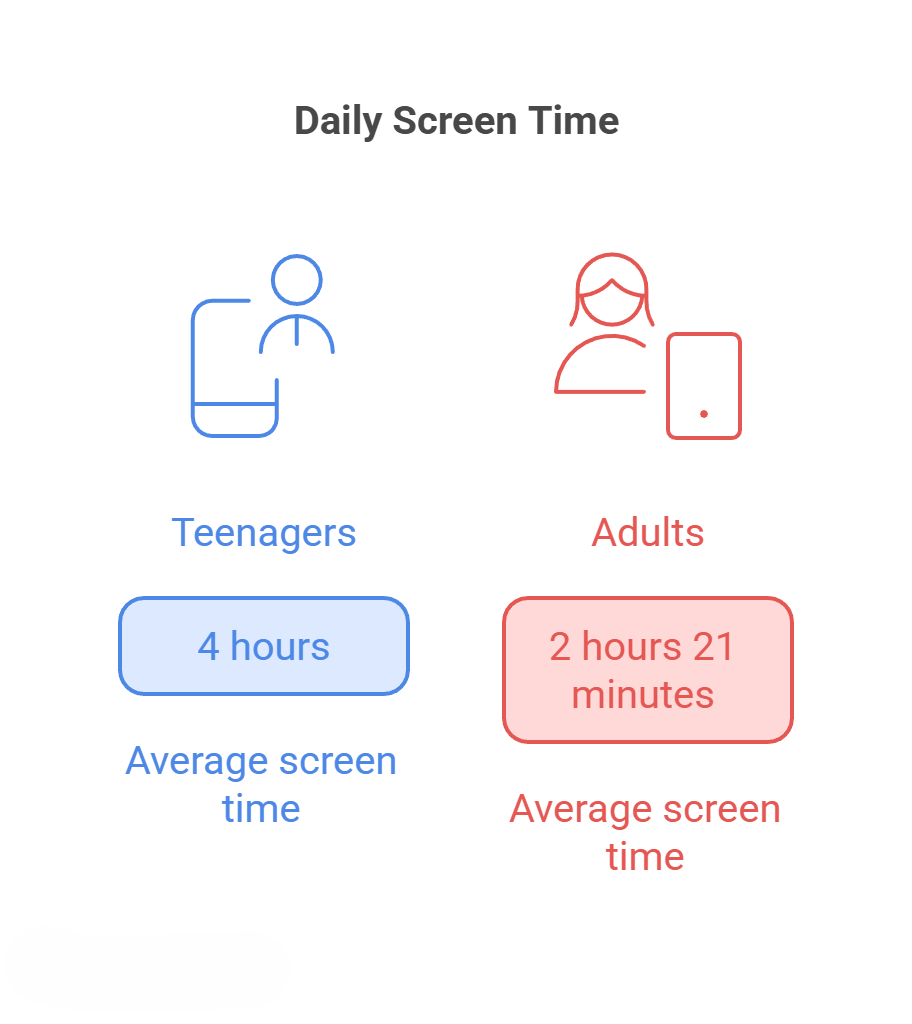
The math is pretty stark. We dedicate roughly 2 hours and 21 minutes to social media alone each day. Compare that to our 7-minute reading average, and you can see the competition for our mental bandwidth.
What’s particularly telling is how this plays out across age groups. Teenagers spend over 4 hours daily on screens, with 41% clocking more than 8 hours. Meanwhile, their reading habits tell a different story entirely.
Social Media’s Reading Impact
Social platforms reshape how we consume information in several key ways:
- Shortened attention spans – We’re trained to expect bite-sized content
- Fragmented focus – Constant notifications interrupt sustained reading
- Visual preference – Images and videos compete with text-based content
- Instant gratification – Books require patience that social feeds don’t train
The Mobile Reading Paradox
Here’s what you might not expect: mobile devices make books more accessible than ever. You can carry thousands of titles in your pocket. Reading apps offer features like adjustable fonts and built-in dictionaries. The barrier to starting a book has never been lower.
The real challenge isn’t access to books. It’s competing with everything else demanding attention on that same device.
Benefits of Reading (Research-Backed)
When you look at what reading actually does for you, the science is pretty clear – this isn’t just a nice hobby. Here’s what researchers have found happens when you make reading a regular part of your life:
1. Educational Performance Improves Across the Board
Regular readers consistently outperform non-readers on standardized tests and cognitive assessments. Reading builds vocabulary naturally, which creates a snowball effect that improves comprehension in every subject.
2. Career and Economic Advantages Compound Over Time
People who read regularly tend to earn more and advance faster in their careers. The improved communication skills, broader knowledge base, and enhanced critical thinking all translate directly to workplace success.
3. Mental Health Benefits Are Measurable
Reading reduces stress levels, improves sleep quality, and can even help alleviate symptoms of depression and anxiety. Just 30 minutes of reading can lower your heart rate and reduce cortisol levels as effectively as meditation.
4. Social Connection and Empathy Develop Naturally
Fiction readers show higher levels of empathy and better social understanding. When you read about different characters and situations, you’re literally training your brain to understand other perspectives and navigate complex social situations.
5. Cognitive Function Gets a Major Boost
Reading enhances cognitive functions and reduces the risk of cognitive decline as you age. Your brain literally changes when you read regularly – research shows that children who read books frequently develop higher intelligence levels and better problem-solving skills compared to those who don’t.
The thing is, these benefits compound over time. The more you read, the stronger these effects become.
Barriers to Reading
Understanding why people don’t read reveals the complex challenges facing literacy today. The barriers aren’t just about personal preference – they’re systemic issues that affect entire communities.
- Lack of Time tops the list of reading obstacles. Americans spend an average of just 7 minutes per day reading compared to over 7 hours on screens. This represents a 40% drop in leisure reading over two decades.
- Cost and Access create significant hurdles. High costs of reading materials particularly impact low-income families, while limited library access in rural areas compounds the problem.
- Digital Distractions fragment attention spans. Studies identify technology distractors as causing 51.95% of reading interruptions, with personal device usage competing directly with sustained reading time.
- Lack of Interest stems partly from limited choice. Yet 78% of students read more when they have freedom to choose their materials, suggesting that engagement issues often reflect restricted access rather than genuine disinterest.
These barriers compound each other, creating cycles where reduced reading leads to decreased literacy skills, which further diminishes reading motivation.
Conclusion
The statistics reveal a reading landscape in transition. While traditional book reading faces serious challenges from digital competition and systemic barriers, it hasn’t disappeared entirely. Young adults maintain some connection to books, and students respond positively when given choice and access. The decline isn’t inevitable – it’s addressable.
What emerges most clearly is that reading’s future depends less on nostalgic appeals and more on practical solutions. Reducing barriers, improving access, and recognizing how reading fits into modern life will determine whether these trends continue or reverse. The question isn’t whether people will read, but how we’ll adapt reading culture to serve both individual growth and societal needs in an increasingly complex world.